How to Make a Gauge Swatch, With the Math
How to make a gauge swatch for knitting or crochet: how big, which stitch, how to block and count it, and what one stitch off does to your width.
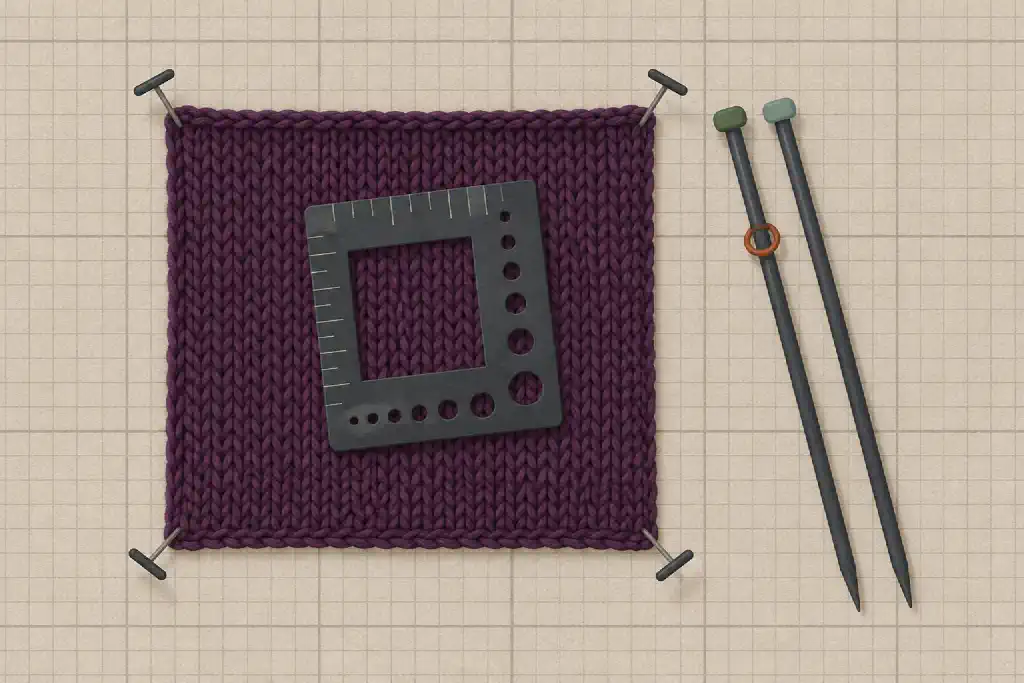
A gauge swatch, also called a tension square, is a small test piece you knit or crochet in your project’s yarn, needle or hook and stitch. Wash and dry it like the finished piece, then measure its gauge (knitting gauge, or crochet gauge): how many stitches and rows fit in 4". Purl Soho, a yarn shop writing about knitting, says everyone knits on “a spectrum between very loose and very tight, including the person who wrote the pattern”. Your swatch shows whether your tension (how tightly you work) matches.
Once you have a count, the gauge calculator works out how many stitches to cast on (put on the needle to start) or chain for your project.
How big to make a gauge swatch
Make it bigger than 4" each way: most sources that give a size say 5–8". They differ within that: 5–6" (Lion Brand, for knit or crochet, and Yarnspirations, for crochet), about 6" each way (Ysolda, a knitwear designer) or 6–8" (The Fibre Co., a yarn company, on knitting). Ysolda’s reason for going past 4": “The stitches on the edges get too distorted.”
For the stitch count, multiply the gauge by the width and divide by 4, as Cast-on for a width does. At 26 stitches per 4", a 6" knitted swatch takes 39 stitches. Crochet at 13 single crochet (a short basic stitch; UK double crochet) per 4" works out to 19.5 for 6", so work 20 stitches across (6⅛").
If your stitch pattern repeats, cast on at least one full repeat and finish at least one full vertical repeat before you bind off (close the last row so it can’t unravel), Purl Soho says.
Which stitch, needle or hook to swatch with
Work the stitch the pattern’s gauge names (how to read a knitting pattern explains where to find it). Yarnspirations, on crochet, says to make a swatch for each stitch pattern if the pattern gives a gauge for each, and “If no pattern is given for the gauge, work in whatever the main stitch for the item is.”
Use the project’s yarn and the same needle or hook, since material can change gauge: Purl Soho says so of needles, and Sarah Maker, a crochet blog, of hooks. Cast on “using the same technique you’ll use for your project”, Lion Brand says, and bind off loosely.
Wash and block it like the finished piece
Patterns usually give gauge after blocking (wetting a piece and drying it to shape), as the gauge calculator guide explains.
Before you wash it, count it (see counting below). Lion Brand’s post: “Note your stitch and row gauge because it’s all about to change!” Ysolda, on knitting, says this lets you check a sweater on the needles. Then follow Lion Brand: “Wash (and dry) your swatch in the same way that you’ll care for your finished piece.” Block it only if you’ll block the finished piece, a Lion Brand reply in the comments says.
Ysolda’s wet blocking: “Let the swatch soak for a while, squeeze the water out with towel and lay flat to dry.” You don’t need to stretch it, she adds. Follow the laundering instructions on the yarn label, and never wring or rub it: rubbing can felt (mat together) yarns not made to be machine washable, Stitch Clinic warns. Boards with grid lines, such as a set of four 12" × 12" interlocking blocking boards with grid lines ad , give you lines to square the edges against, in our view.
Then give it time. Stolen Stitches, a knitting site, lets a swatch sit “for a few days so that it will revert to a more relaxed state”.
How to read a gauge swatch
Lay it flat and don’t pull it. Lion Brand: “Don’t cheat by stretching it!”
Knitting. Lay a ruler over the middle 4" of stockinette: knit on the right side, the side that will show, and purl on the wrong side (a purl stitch is the reverse of a knit stitch). Each stitch is a V. Count the Vs to the 4" mark, including a partial V at the end, as Elizabeth Smith Knits shows. For rows, turn the ruler upright and count up through the Vs. In garter stitch (every row knit), count the ridges and double them. Purl Soho’s example: “25 rows (or 12.5 ridges) over four inches”.
Crochet. Tall stitches such as double crochet (UK treble crochet) are easier to count by their posts (the upright stems), says Sigoni Macaroni, a crochet blog. Short ones such as single and half double crochet (UK half treble) may be easier to count by the Vs on top. The foundation chain (the starting chain) isn’t a row, but the first row worked into it is. In single crochet, the turning chain 1 at the start of a row “almost never counts as a stitch (unless stated otherwise)”.
Gauge swatch math: from your count to a width
Stitches per inch is your count divided by 4: Purl Soho’s example swatch, 18.75 stitches over 4", is 4.69 per inch.
Part-stitches matter. The Fibre Co., on knitting: “Across the entire project, they add up to a significant measurement.” For a 20" piece, 18.75 per 4" gives 94 stitches, and rounding the gauge up to 19 gives 95, one stitch too many.
One stitch off per 4" moves a whole piece. Say a knitting pattern at 24 stitches per 4" casts on 216 for 36", and a crochet one at 16 per 4" works 80 stitches for 20". At a stitch more or less:
| Your gauge per 4" | Width of the pattern’s count (216 knit / 80 crochet) |
|---|---|
| Knit 23 (pattern 24) | 37 9/16" |
| Knit 25 (pattern 24) | 34 9/16" |
| Crochet 15 (pattern 16) | 21 5/16" |
| Crochet 17 (pattern 16) | 18 13/16" |
These patterns are examples; the widths come from the gauge calculator’s math. Put your own count into the gauge calculator: “Cast-on for a width” for a new count, or “Resize a pattern” to keep your gauge. Then weigh the same swatch on a digital kitchen scale that reads grams in 1 g steps ad , and the yarn calculator works out how many skeins (wound bundles of yarn) to buy.
When your swatch doesn’t match
Too many stitches per 4" means going up a needle or hook size, and too few means going down, as Lion Brand’s post says. The knitting needle size chart and crochet hook size chart list the next size up or down in mm. Then swatch again.
If you like the fabric but not the count, Stolen Stitches says you may “knit a different pattern size or perhaps try a different yarn”, meaning the garment size, not the needle.
Row gauge. If your stitch count matches but rows don’t, see the gauge calculator’s FAQ. Pieces built sideways are the exception, a reply in the comments on Lion Brand’s post says, “as the width of your knit/crochet piece would equal the height of the garment”. And in crochet, Sarah Maker suggests working the “golden loop”, the first loop after you insert the hook: lift it for taller stitches if you have too many rows, or snug it down if you have too few.
FAQs
Can I blow-dry my gauge swatch?
Stitch Clinic, writing about knitting, says no: “No speeding it up with a hair dryer or any heat. A fan to circulate air gently would be fine.”
Should I pin my gauge swatch?
For knitting, The Fibre Co. pins a swatch out only if the project will be stretch-blocked (pinned to shape while it dries). Otherwise, it says, leave it “in its relaxed, unpinned, state” to dry for a more accurate reading.
What should I do with my gauge swatches?
Gianna of Purl Soho binds hers off and keeps a swatch binder, and says that if you’re short on yarn, “you can absolutely skip the bind off and reuse that yarn!” Weigh and measure it for the yarn calculator first.