How Many Yards in a Skein of Yarn? Why Labels Differ
How many yards in a skein? There's no standard: read the label's yards and grams, compare yards per 100 g, then let the yarn calculator count skeins.
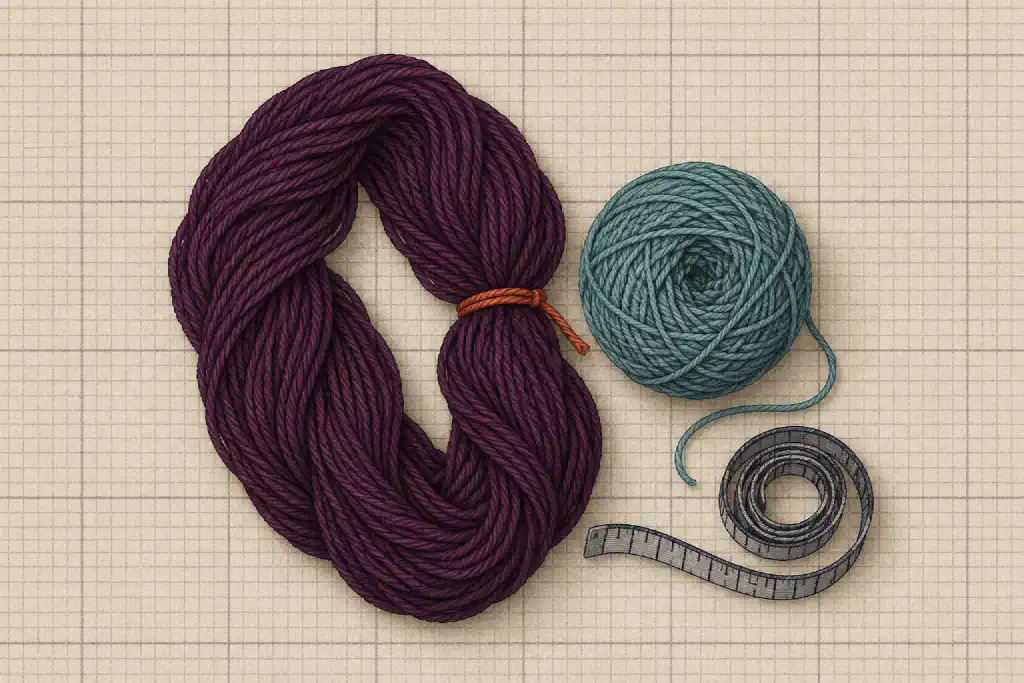
There’s no standard number of yards in a skein. A skein, the wound bundle yarn is sold in, holds whatever length its maker puts in it, and the label tells you how much: yards (often meters too) and grams or ounces. The word is also a unit: The Yarn Diary on yarn.com notes that a skein can simply mean “one package of yarn”, whatever it weighs.
To compare two yarns, use yards per 100 g. To work out how many skeins to buy, the yarn calculator turns your swatch (a small test square you knit or crochet first) and your label into a skein count, for knitting or crochet.
How many yards in a skein: read the label
The yardage and the weight sit side by side on the label, and you need both. WEBS, writing on yarn.com, describes yardage as “how much length there is in a skein”, a figure that “directly corresponds with the physical weight of the skein”.
In this section, “weight” means grams or ounces. “Yarn weight” also names a yarn’s thickness category; the yarn weight chart sorts out the two.
Why two skeins hold different yardage
Three things move a skein’s yardage: how much yarn the maker puts in it, how thick the strand is, and what it’s made of. The table shows all three on six yarns from one maker, Lion Brand, so that different companies’ labeling habits don’t muddy the comparison.
Each page names a weight category: 3 Light / DK (DK is short for double knitting), 4 Medium / Worsted or 6 Super Bulky; the yarn weight chart explains the scale.
| Yarn (Lion Brand) | Category on its page | Yards / grams per skein | Fiber on its page | Yards per 100 g |
|---|---|---|---|---|
| 24/7 Cotton DK, solids | 3 Light / DK | 273 yd / 100 g | 100% cotton | 273 |
| 24/7 Cotton DK, prints | 3 Light / DK | 219 yd / 80 g | 100% cotton | 274 |
| 24/7 Cotton | 4 Medium / Worsted | 185 yd / 100 g | 100% mercerized cotton | 185 |
| Fishermen’s Wool, solids (not prints) | 4 Medium / Worsted | 465 yd / 227 g | 100% pure virgin wool (one color is a blend) | 205 |
| Pound of Love | 4 Medium / Worsted | 1,020 yd / 454 g | 100% premium acrylic | 225 |
| Wool-Ease Thick & Quick, base figure (not prints, stripes or metallic) | 6 Super Bulky | 106 yd / 170 g | 80% acrylic, 20% wool (most colors) | 62 |
Figures are from each yarn’s product page on October 27, 2026. The fiber column uses each page’s own wording (“mercerized” is Lion Brand’s term), and the last column is our label converter’s math. Labels change, so check yours.
The put-up: grams per skein aren’t standard
The put-up is how a yarn is packaged and how much goes in one. On this one maker’s pages alone, a skein weighs 80, 100, 170, 227 or 454 g, and Pound of Love’s 16 oz put-up holds 1,020 yd.
The two DK rows show why yards per skein alone can mislead. They’re the same yarn: the solid colors come in 100 g skeins and the prints in 80 g. Per skein, that’s 273 yd against 219 yd. Per 100 g, it’s 273 against 274, within a yard. And on this one maker’s labels, a skein of worsted runs anywhere from 185 to 1,020 yd (465 yd for Fishermen’s Wool solids).
Thickness: thinner yarn, more yards per gram
The thinner the strand, the more of it fits in 100 g. The Yarn Diary compares two 100 g skeins, one DK and one fingering, a much finer yarn: the fingering has “far more yardage because the strand is thinner”. Its advice: “Always plan your projects by yardage, not by skein weight alone.”
The table shows how far apart labels can sit. Thick & Quick solids, listed as 6 Super Bulky, near the thick end of the scale, give 62 yd per 100 g. 24/7 Cotton DK gives 273. Their fibers differ too, so the pair shows the spread, not thickness alone. To find a yarn’s category from its label, see how to tell yarn weight.
Fiber and construction
Even within one category, yards per gram move: the three 4 Medium / Worsted rows give 185, 205 and 225 yd per 100 g.
The sources point to fiber and construction (how the strand is spun and twisted), though not for these yarns in particular. Lion Brand’s blog puts it down to fiber: “different fibers weigh different amounts. Cotton and silk, for instance, are much heavier than wool, so you’ll get much less yardage per pound.” Construction counts as well, the same post notes: “Acrylic can vary tremendously depending on the yarn construction.” And WEBS names lofty mohair blends (airy, fluffy yarns with mohair, which is goat hair) among the yarns that tend to give more yardage. The product pages don’t say why their own figures differ, so read the table as examples, not proof of a fiber rule.
How to compare skeins: yards per 100 g
Comparing per 100 g takes the put-up out of the picture:
- Read the yards and grams on each label.
- Type them into the label converter on the yarn weight chart. It gives yards per 100 g and shows its math, whatever the skein size.
- Compare the two figures.
Joan Forgione of Paper Moon Knits does the same by hand: for a 50 g skein, she doubles the yardage to get a 100 g figure. Her rough guide by category gives 200–240 yd per 100 g for worsted and 240–280 for DK (her names, not the labels’ numbers). The table’s DK fits, as do two of the three worsted labels; 24/7 Cotton, at 185, falls below. A rough guide is just that.
For a substitute yarn, matching yards per 100 g is only a start: it doesn’t promise the same gauge (stitches per 4", the figure the gauge calculator works from), so swatch first, as the yarn weight chart’s guide to substituting a yarn explains.
Skein, ball, hank or cake: what you’re buying
The shape changes how you start, not how much yarn you get. The Yarn Diary gives each a drawback:
- Skein: an oblong bundle, ready to use without winding. It gradually loses shape as you use it.
- Ball: round, so it rolls off the table and across the floor. The Yarn Diary calls true balls usually hand-wound and rarely sold. One maker uses the words loosely: Lion Brand’s Pound of Love page says “per skein” in one place and “one ball” in another for the same put-up.
- Cake: a flat-bottomed cylinder wound on a ball winder (a tool that winds yarn into a cake). It’s center-pull: the yarn comes from the middle, so the cake stays put. The drawback, in The Yarn Diary’s words: “Rarely sold this way”.
- Hank: a large loop twisted into a coil, common with hand-dyed yarns. The drawback: you can’t knit or crochet straight from it.
To use a hank, drape it over a swift, a frame that holds the loop open and turns as you wind, such as a birch umbrella yarn swift that clamps to a table ad . Then wind it into a cake with a ball winder, such as a hand-operated ball winder ad . That winder’s listing says it winds up to 100 g (3.5 oz), so check your skein’s grams against it.
From yards to how many skeins to buy
Count yards, not skeins. When you swap yarns, Lion Brand’s support page notes, the new skein may weigh more or less, and its yardage tells you how much to buy. A pattern’s skein count is in its own yarn’s skeins: when a reader ran short on one of Lion Brand’s patterns, the company replied on Wool-Ease Thick & Quick’s page that the pattern “was originally made in our Wool-Ease Thick & Quick Bonus Bundle skeins, which had twice the yardage of the regular Wool-Ease Thick & Quick skeins.”
So turn the pattern’s skeins into yards first, from its yarn’s label. Then divide by your yarn’s yards per skein and round up. Better still, start from your own swatch, which measures your yarn, stitch and tension rather than the pattern’s (why a swatch, not a yardage chart): from that swatch and your label’s yards and grams per skein, the yarn calculator works out the skeins, rounded up. For a scarf, hat or sweater, see how much yarn each takes.
FAQs
How do you wind a hank without a swift?
Use the backs of two chairs or a helper’s outstretched arms: The Yarn Diary lists both alongside a swift. Either way, the whole hank gets wound into a ball before you start, and Easy Crochet, a crochet blog, says the same before you crochet.
Should I wind a skein into a cake?
You don’t have to, since a skein is ready to use. If a center-pull skein keeps coughing up a tangled clump, though, The Yarn Diary suggests winding it into a cake with a ball winder, and some crafters rewind a skein once it gets floppy. Whatever the shape, your swatch and the label’s yards and grams per skein are all the yarn calculator needs.