How to Read a Knitting Pattern: Sizes, Repeats and Charts
How to read a knitting pattern for beginners: the materials, gauge, sizes in parentheses, knitting abbreviations, repeats, RS and WS, and charts.
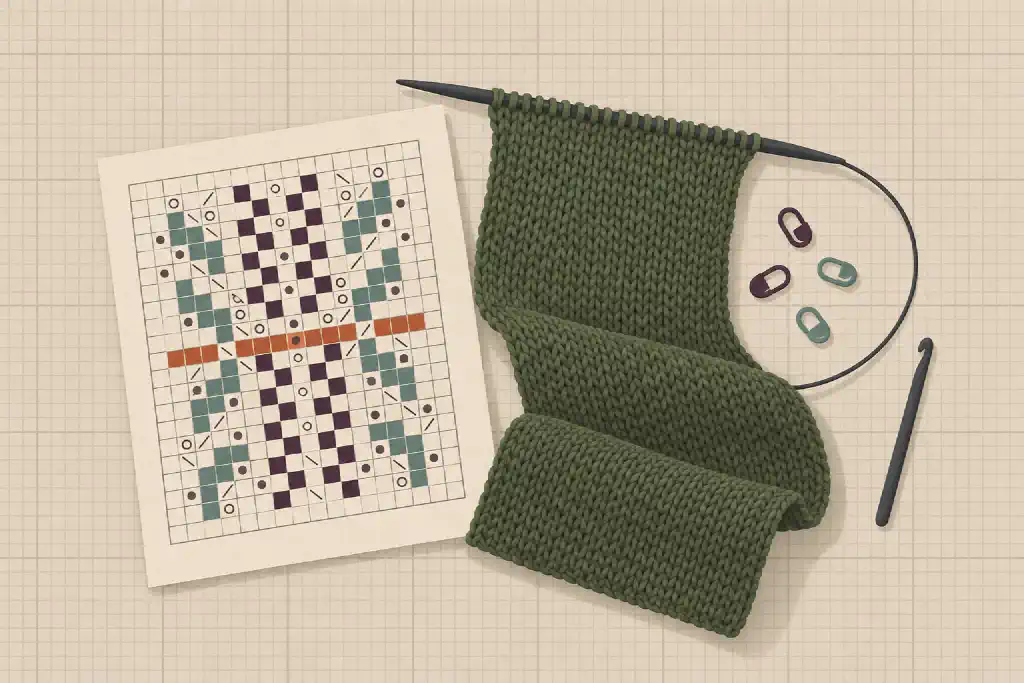
A knitting pattern reads from top to bottom: the materials, the gauge (how many stitches and rows fit in 4"), the sizes, the abbreviations, then the instructions row by row, sometimes with a chart. The Craft Yarn Council (CYC) calls it a language with “many abbreviations and terms, which save space and make patterns easier to read”.
If your swatch (a small test square you knit first) doesn’t match the pattern’s gauge, a needle change is the usual fix (how to make a gauge swatch). If you like the fabric your swatch makes, the gauge calculator rescales a stitch count to yours.
Materials: yarn, yardage and needles
The amounts on the materials list are a starting point: Purl Soho, a yarn shop, notes that “a pattern’s yardages and needle sizes are just recommendations”. Each line of the list has a tool:
- Yarn weight (its thickness category): the yarn weight chart.
- Skeins (the wound bundles yarn is sold in) or yards: how many yards in a skein converts them, or weigh your swatch and the yarn calculator works out the skeins for your size.
- Needles: the knitting needle size chart converts mm to US sizes.
Gauge: match it before you cast on
Every stitch count in a pattern assumes its gauge. So check yours on a swatch before you cast on (put your first stitches on the needle). If you’re off, Purl Soho says “you may need more or less yarn or a different needle size”, and the swatch guide’s section on when your swatch doesn’t match says which way to change needle size.
If you like your fabric at a different gauge, rescale the counts instead, but check the result against the stitch pattern. Our example: a pattern casts on 74 stitches at 16 per 4", 18½" wide, in 2×2 ribbing (columns of 2 knit and 2 purl stitches). That rib needs a multiple of 4, plus 2: 4 stitches per repeat, plus 2 to balance the edge. At 18 per 4", Resize a pattern gives 83 stitches, which doesn’t fit.
Cast-on for a width, with the multiple filled in, gives 82 stitches (18¼").
Sizes: the numbers in parentheses
One line carries every size. In Purl Soho’s description, the smallest size comes first and the larger ones follow in parentheses, so “2 (3, 4) skeins” means 2 for a Small, 3 for a Medium and 4 for a Large. That applies “to every instruction in the pattern”.
Tin Can Knits uses the same layout, and Emily Wessel’s tutorial names the catch: “Don’t cast on 66, then 72, then 78; find the number for your size, and cast on that number.” Both companies also put the stitch count you should have in square brackets after a row, as in Tin Can’s “[12 (14, 16, 18, 20) sts]”. That’s a check, not a step.
Knitting abbreviations: the pattern’s key and CYC’s list
Start with the pattern’s own abbreviations and its Notes or Special Instructions, which Purl Soho says patterns with unusual techniques include.
Then use CYC’s US-terms knitting abbreviations master list. It warns that “designers and publishers may use special abbreviations in a pattern, which you might not find on this list.” A few common terms, from CYC:
- rnd: “round”, one pass around a piece knit in a circle.
- St st: “stockinette stitch”. CYC’s pattern guide says working in it means to “alternate a knit row with a purl row”.
k2tog and SSK are decreases; M1 and KFB add a stitch. The gauge calculator gives CYC’s full definitions.
Repeats: asterisks, brackets and parentheses
Repeats fit a long row on one line. Among CYC’s terms:
*: “repeat the instructions following the single asterisk as directed”;[ ]: “work instructions within brackets as many times as directed”;( ): “work instructions within parentheses as many times as directed or work a group of stitches all in the same stitch or space”.
Pattern writers don’t all use the marks the same way, and parentheses also carry sizes. Purl Soho says so: “In addition to indicating different sizes, parentheses also specify a sequence of stitches to repeat inside of a larger repeat.” A bracketed count at the end of a row is a stitch check, not a repeat. The pattern’s notes tell you which is which.
RS and WS: right side and wrong side
RS and WS name the face of the work toward you. In CYC’s example, “Row 1 (RS): Knit.” means you knit every stitch on Row 1, “the right side of the piece (RS)”, and “Row 2 (WS): Purl.” means you purl across the wrong side.
A sample pattern, decoded
Here’s a short two-size sample (ours, for illustration) and what each line means.
CO 22 (26) sts.
Row 1 (RS): K2, *p2, k2; rep from * to end.
Row 2 (WS): P2, *k2, p2; rep from * to end.
Rep Rows 1 and 2 until piece measures 2" from beginning, ending with a WS row.
Next row (RS): K1, [yo, k2tog] 10 (12) times, k1. [22 (26) sts]
The repeats follow CYC’s terms; the sizes and the closing count follow Purl Soho and Tin Can Knits.
- CO 22 (26) sts: cast on 22 stitches for the first size, 26 for the second.
- Row 1: knit 2, then repeat “purl 2, knit 2” to the end, 5 times for 22 stitches (2 + 5 × 4) or 6 times for 26.
- Row 2: work each stitch as it faces you: “knit the knit stitches and purl the purl stitches”. The two rows make 2×2 ribbing.
- Rep Rows 1 and 2: to measure, lay the piece flat without stretching it, and stop after a Row 2. A pendant-style stitch and row counter ad tracks which row you’re on.
- Next row: knit 1, then a yarn over (yo: take the yarn over the needle) and a k2tog (knit 2 together), 10 (12) times, then knit 1.
- [22 (26) sts]: a yarn over adds a stitch and a k2tog takes one away, so you still have 22 (26).
How to read a knitting chart
A chart draws the instructions as a grid. Each square is one stitch, and Yarnspirations’ guide says to read it “from the bottom to the top”. CYC’s symbols page says: “For the most part each symbol represents a stitch as it looks on the right side of the work.”
So when you work flat, “all right side rows are read from right to left and wrong side rows from left to right”. In the round (in a continuous circle, making a tube), every row reads right to left. Symbols vary, so CYC says to “Always refer to the pattern key for variations in the knit symbols.”
If you crochet: what carries over
The repeat marks work the same way: CYC’s crochet abbreviations list the same *, [ ] and ( ) symbols. Two things differ.
- The slip knot, the loop you put on the needle or hook before you start. CYC: “In knitting, the slip knot always counts as a stitch.” In crochet, it never does.
- Stitch names. CYC’s crochet terms are US, and UK patterns name the stitches differently. For example, US single crochet is UK double crochet, US half double crochet is UK half treble, and US double crochet is UK treble.
For hook sizes, see the crochet hook size chart.
FAQs
What does pm mean in knitting?
In CYC’s list, “pm” is “place marker” and “sm” is “slip marker”. A stitch marker is a small ring that marks a place on the needle. Soft ring stitch markers ad come in two sizes on that listing: small for 2–3.75 mm needles, large for 3.75–8 mm.
How do you read a knitting pattern in the round?
Look for the join at the start. Tin Can Knits’ Barley hat begins “cast on 66 (72, 78, 84, 90, 96) sts, PM and join for working in the round, being careful not to twist the cast-on.” See knitting needle types for circular and double-pointed needles.
What does a dash mean in a knitting pattern?
In Purl Soho’s description, a dash (or a zero) where your size’s number would be means that instruction doesn’t apply to your size, and “you can move on to the next instructions”.
Related
Source: Craft Yarn Council’s www.YarnStandards.com