How to Tell Yarn Weight, With or Without the Label
How to tell yarn weight: read the label's symbol, type or gauge, or count wraps per inch (WPI) if there's no label, then check with a swatch.
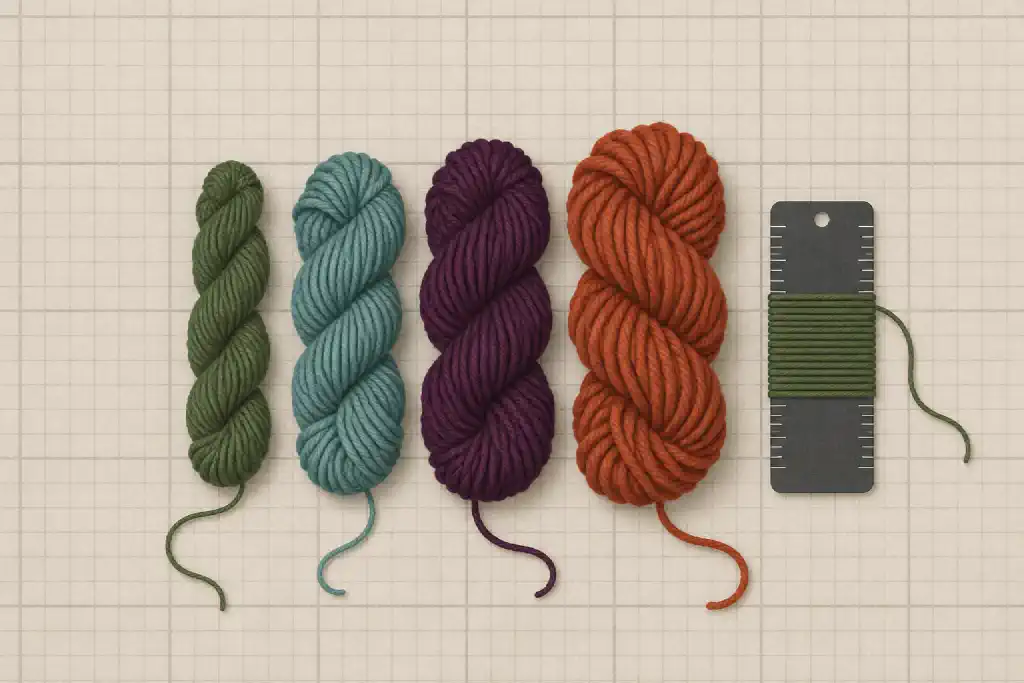
Yarn weight means how thick a yarn is. The Craft Yarn Council (CYC) publishes a Standard Yarn Weight System, and its table runs from 0 Lace to 7 Jumbo. The label answers it fastest, in one of three ways: a weight symbol, a type name like “DK”, or its gauge (how many stitches fit in 4") with a needle or hook size. With no label, you count wraps per inch (WPI). Either way, a gauge swatch (a small test square you knit or crochet, then measure) is the last check.
Have the label? Type its gauge and needle or hook size into the yarn weight chart, which shows every category that fits.
Read the weight symbol on the label
CYC’s symbol is a drawing of a ball or skein (a loose, wound bundle of yarn) with a number on it, from 0 to 7, “with 0 the finest and 7 the thickest”. If you find it, you have your answer.
CYC’s label symbol runs 0 to 7, and CYC has announced a size 8 that isn’t in its table yet.
If there’s no symbol, look for a type word.
A type name on the label: DK, worsted, sport
A label may print a type word instead of a symbol. Look it up in CYC’s “Type of Yarns in Category” row. A few examples, in CYC’s words:
- “Sport, Baby” are the types under 2 Fine.
- “DK, Light Worsted” are under 3 Light.
- “Worsted, Afghan, Aran” are under 4 Medium.
So if you’re asking “sport or DK?”, CYC puts sport in 2 Fine and DK in 3 Light. Three words cross categories: “Fingering” (0 and 1), “Baby” (1 and 2) and “Roving” (6 and 7). If your label says one of those, use the gauge.
Watch “worsted” too. CYC lists “Light Worsted” under 3 Light and plain “Worsted” under 4 Medium, so check whether the label says light.
No symbol, or an unclear type? Match the gauge and needle or hook size
A label’s gauge is usually measured over 4" or 10 cm, drawn as a little grid or simply listed, with the suggested needle and hook sizes. Compare both with CYC’s ranges. Its knit ranges are for stockinette stitch (knit on the right side, purl on the wrong side) over 4", and its crochet ranges are for single crochet (UK double crochet) over 4".
Go by the millimeters. CYC says “letter and number sizing vary from company to company”, so rely on the mm on the package. Here are two neighboring rows of CYC’s table:
| CYC category | Knit gauge, 4" (sts = stitches) | Needle | Crochet gauge, 4" | Hook |
|---|---|---|---|---|
| 2 Fine | 23–26 sts | 3.25–3.75 mm (US 3 to 5) | 16–20 sts | 3.5–4.5 mm (E–4 to 7) |
| 3 Light | 21–24 sts | 3.75–4.5 mm (US 5 to 7) | 12–17 sts | 4.5–5.5 mm (7 to I–9) |
Source: Craft Yarn Council’s www.YarnStandards.com
Here’s a worked example of our own (the label figures are made up):
- Knitting: a label giving 22 stitches over 4" on 4 mm needles fits only 3 Light. A label giving 23 stitches fits both 2 Fine and 3 Light on gauge, so the needle decides: 3.5 mm points to 2 Fine, 4 mm to 3 Light.
- Crochet: a label giving 17 single crochet over 4" fits both 2 Fine and 3 Light. A 5 mm hook settles it, since only the 3 Light range (4.5 to 5.5 mm) includes it.
No label: count wraps per inch (WPI)
CYC says wraps per inch can help “identify the weight of yarn if its label is missing”. You need a ruler and something with a consistent circumference, like a pencil.
- Wrap the yarn around the pencil for a few inches.
- Keep it snug, with the wraps side by side: no overlapping and no large gaps. CYC’s caution: “Don’t pull the yarn too tightly to avoid skewing the measurements.” If you’re unsure of your tension, it suggests practicing on a yarn whose weight you know.
- Count how many wraps fit in an inch. Measure in a few places, as you would a gauge swatch.
Instead of a pencil, you can wrap an acrylic WPI ruler ad . Any WPI ratings or chart that come with it are the seller’s, so compare your count with CYC’s table:
| CYC weight | WPI |
|---|---|
| 0 Lace | 30-40+ |
| 1 Super Fine | 14-30 |
| 2 Fine | 12-18 |
| 3 Light | 11-15 |
| 4 Medium | 9-12 |
| 5 Bulky | 6-9 |
| 6 Super Bulky | 5-6 |
| 7 Jumbo | 1-4 |
Source: Craft Yarn Council’s www.YarnStandards.com
CYC says this chart is based on “WPI information shared by industry experts” and the two WPI lists it links, from The Woolery and Ravelry. It adds a plain caveat: “Keep in mind that WPI is subjective, and results will vary depending on how tightly the yarn is wrapped.”
Why WPI, the label and your swatch can disagree
- The WPI ranges overlap. In CYC’s table, 14 WPI falls in 1 Super Fine, 2 Fine and 3 Light, and 12 WPI in 2, 3 and 4. Only 7 Jumbo shares no number with another row.
- The gauge and tool ranges overlap too. For example, knit gauge for 2 Fine and 3 Light shares 23–24 stitches. Crochet gauge overlaps between several neighbors, and needle and hook ranges meet at their ends: a 4.5 mm needle is the top of 3 Light and the bottom of 4 Medium.
- Some type names cross categories, as in the type-name section above.
- Your tension matters. Tension is how tightly you wrap the yarn or work the stitches, and it moves both your WPI and your swatch.
CYC says as much about its own numbers: “GUIDELINES ONLY: The above reflect the most commonly used gauges and needle or hook sizes for specific yarn categories.”
Check it with a gauge swatch
In our view, a swatch is the strongest check, though not proof. It doesn’t work for 0 Lace. CYC’s footnote: “Lace weight yarns are usually knitted or crocheted on larger needles and hooks to create lacy, openwork patterns. Accordingly, a gauge range is difficult to determine. Always follow the gauge stated in your pattern.”
For other yarns, here’s a way to use a swatch to identify one (our suggestion, not CYC’s):
- Pick a starting tool. With a label, use its suggested needle or hook. After WPI, pick a size from the middle of that category’s range. If WPI left two or three categories, use the middle one. At 12 WPI that’s 3 Light, so try a 4 mm needle or a 5 mm hook, both inside its ranges.
- Work the swatch the way CYC measures: knit it in stockinette, or crochet it in single crochet. Make it a little larger than 4" each way, so you can count 4" away from the edges (more in how to make a gauge swatch). A needle and hook gauge with a stitch-gauge ruler ad does two jobs here: it checks an unmarked needle’s size (the listing describes its hook sizer for Susan Bates inline hooks only) and measures your stitch gauge.
- Match the count. Type your stitches over 4" and your needle or hook mm into the yarn weight chart. It shows every category that fits. If your count falls where two ranges overlap, the yarn sits between those neighbors, and the gauge your pattern asks for is the number to match.
CYC’s general advice applies once you start a project, too: “Always work up a gauge swatch before starting a project.” When you know the yarn, the gauge calculator works out how many stitches to cast on for a width from your swatch. For that, measure the swatch after washing or blocking it the way its label or pattern says.
Common mistakes
- Reading grams as “weight”. The grams or ounces on a label tell you how heavy the ball is, not which category it’s in.
- Trusting the US number or letter over the mm. Sizing varies between companies; the mm doesn’t.