Knitting Needle Types and Materials: What Each One Is For
Knitting needle types (straight, circular, interchangeable, double-pointed) and materials: what each shop says they're for and which to start with.
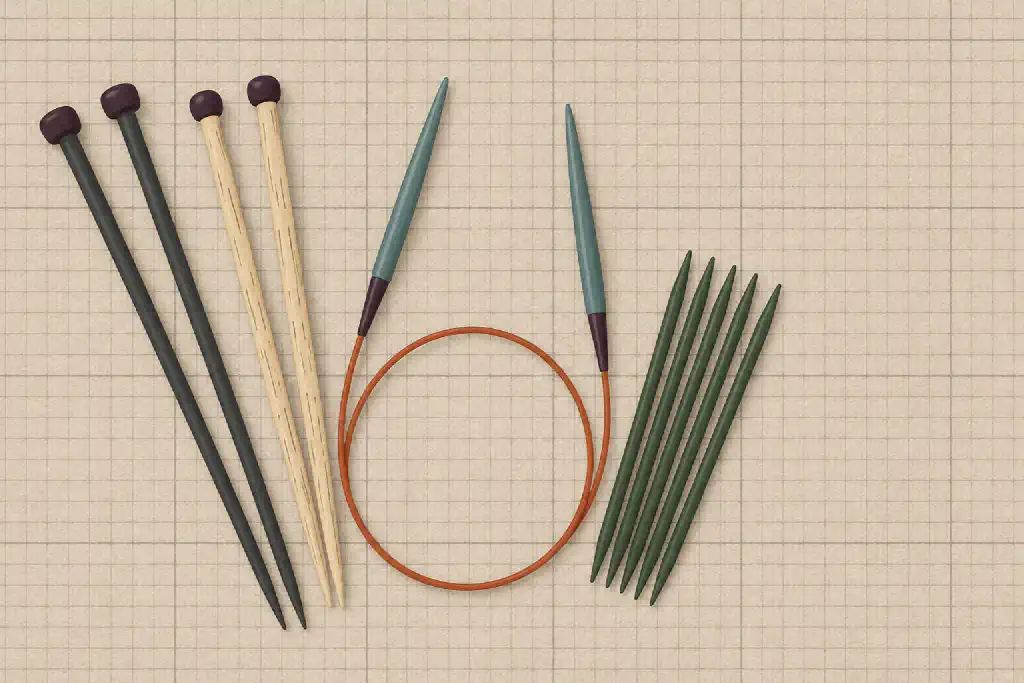
Shops sort knitting needles into four main kinds:
- straight needles, one point each, sold in pairs;
- fixed circular needles: two short needle tips (the pointed ends) joined for good by a flexible cord, the cable;
- interchangeable circulars, whose tips and cables come apart so you can swap them;
- double-pointed needles (DPNs), short and pointed at both ends.
Paradise Fibers, a yarn shop, counts those four; Mary Maxim, a craft retailer, folds them into three: straight, circular and double-pointed. As for materials, Knit Picks, a needle maker, names plastic, wood (bamboo included) and metal as the most common.
The kind decides whether a needle knits flat (back and forth in rows), in the round (joined in a circle), or both. For sizes, the knitting needle size chart gives each needle’s mm with its US number.
Types of knitting needles by shape
Straight knitting needles
Straights are the simple choice for flat pieces, and only flat pieces. Each has a point at one end and an endcap (a stopper) at the other, and Mary Maxim puts them at “Typically 10 to 14 inches long”. That length is their limit: in Knit Picks’ words, “the length of the needle limits how many stitches can be held.”
Circular knitting needles
A circular knits flat like a straight, or in the round. Paradise describes it as “two short tips connected by a flexible cable” The catch is the fixed length. Knit Picks explains that the cable length “can restrict the amount of stitches that can be comfortably knit”.
Interchangeable knitting needles
An interchangeable set is one way to cover all those lengths. The tips and cables “screw or click together”, per Paradise, and Knit Picks, whose own sets use a threaded join, does the math: “a set of 9 tips with 3 cable lengths provides the equivalent number of options as 27 fixed circular needles.”
Most sets cover 3.5–8 mm (US 4–11): Paradise gives that range in US sizes, and the mm come from the Craft Yarn Council’s (CYC) chart. One example is Knit Picks’ wood interchangeable set with nine pairs of tips, 3.5–8 mm (US 4–11) ad (the same maker as the 27-needle math above); its listing says it includes metal tightening keys. Before buying, see the cost question in the FAQs below.
Double-pointed needles (DPNs)
DPNs are for circles too small for a circular: Paradise lists “socks, mittens, hat crowns, and glove fingers.” The stitches sit on several needles while you knit them with a spare one, and Knit Picks warns they’re “not ideal for knitting flat or knitting larger circumferences in the round.”
Knitting needle materials: bamboo, wood, metal and plastic
Purl Soho says gauge can vary with material, meaning the number of stitches that fit in 4". The gauge swatch guide shows how to check yours on a swatch (a small test square).
Bamboo and wood knitting needles
Wood and bamboo grip the yarn, which is why the guides send slippery yarns their way. Paradise finds bamboo “slightly grippy” and good with silk, and Knit Picks calls wood’s texture “ideal for working with slippery yarns such as silk”.
The trade-offs are flex and wear. Smaller wood sizes “can flex a little, which some knitters love and others find annoying”, Paradise writes, and SweetGeorgia Yarns, a yarn company, warns that over time “the surface can get rough and snag your yarn.”
Metal knitting needles
Metal is the slick end of the range, and the guides we read agree on that. Knit Picks calls metal “the strongest of the knitting needle materials as well as the slickest”, with sharper points that suit lace (openwork) and cable patterns (stitches crossed into twisted ropes).
That slickness cuts both ways. SweetGeorgia finds metal “can be too slippery for certain yarns”, and Yarnspirations calls it “more suitable for more advanced knitters who are comfortable with their tension”, meaning how tightly you hold the yarn.
Not all metals behave alike. Knit Picks says its nickel-plated needles suit wool, but notes “Nickel can also be a common allergy” and calls that metal “not an ideal fit for every knitter”.
Plastic and carbon fiber knitting needles
Plastic is the budget option, and the one the guides agree on least. Yarnspirations calls it “the least expensive option” with “a smoothness comparable to wooden knitting needles”; Knit Picks finds plastic needles tend “to be stickier”.
Durability is plastic’s weak spot. SweetGeorgia rates plastic “not as durable as their metal or wooden counterparts”, and Knit Picks calls it “very prone to bending and even breaking in smaller sizes.”
Carbon fiber, a newer material, “combines the lightness of wood with the strength and smoothness of metal”, in Paradise’s description.
How to choose your first knitting needles
The kind. Here the shops disagree outright. Mary Maxim: “We often recommend straight needles for beginners since they feel familiar and unintimidating”. Knit Picks adds that the endcaps on straights “help to make it clear which end to work from.” Paradise starts beginners on a circular instead: “A 24 inch or 32 inch circular in US 7 or US 8 is the most versatile first pair” (4.5 or 5 mm), knit flat at first and used in the round later. Our reading of the sections above: a flat first project, like a scarf or a dishcloth, works on either, and a hat knit in the round needs a circular or DPNs.
The material. Each source names its own pick:
- Wood or bamboo: Paradise, for the grip. SweetGeorgia calls that grip “a bonus for beginning knitters”, and Knit Picks calls its wood needles “great for beginner knitters”.
- Bamboo over wood: Yarnspirations, which says bamboo costs less than wood and calls it “a great choice for beginners over wooden knitting needles like birch.”
- Plastic: Yarnspirations calls it “a great first set”, and SweetGeorgia “perfect for the beginning knitter.”
- Metal: Knit Picks suggests aluminum for “newer knitters who prefer metal needles”, though it also notes aluminum needles “can bend easily”. Paradise warns: “Slippery metal can be frustrating during the tension building phase.”
The size. Take it from your yarn label or pattern, then find it in the knitting needle size chart. No label size? The yarn weight chart gives the needle range for each yarn weight. If straights suit you and your label calls for 4.5 mm, a short 9" pair of bamboo straight needles in 4.5 mm (US 7) ad is one option.
FAQs
Are interchangeable knitting needles worth it?
If you’d otherwise buy many circulars, Knit Picks’ 27-needle math above makes the case, though it notes “a larger up front cost”. Paradise suggests starting with one or two circulars for your first pattern: “Once you know what you like, invest in an interchangeable set.”
Do bamboo knitting needles break easily?
They can. SweetGeorgia warns that wood and bamboo needles “are prone to breaking”. Yarnspirations, in its section on wooden needles (bamboo included), calls them the opposite: “They are durable and lightweight”. Knit Picks, writing about its own wood needles, says they “can break if sat on or chewed on by a pet”, but that well-cared-for ones can last a lifetime.
Can you take knitting needles on a plane?
In the US, yes. The Transportation Security Administration (TSA) allows knitting needles in carry-on and checked bags, and asks that sharp objects in checked bags be “sheathed or securely wrapped”. It adds: “The final decision rests with the TSA officer on whether an item is allowed through the checkpoint.”
Source: Craft Yarn Council’s www.YarnStandards.com