What Is DK Yarn? How It Compares With Worsted and Sport
DK (double knitting) is CYC 3 Light: usually 21–24 knit sts per 4" on 3.75–4.5 mm needles, 12–17 single crochet on 4.5–5.5 mm hooks. Worsted and sport compared.
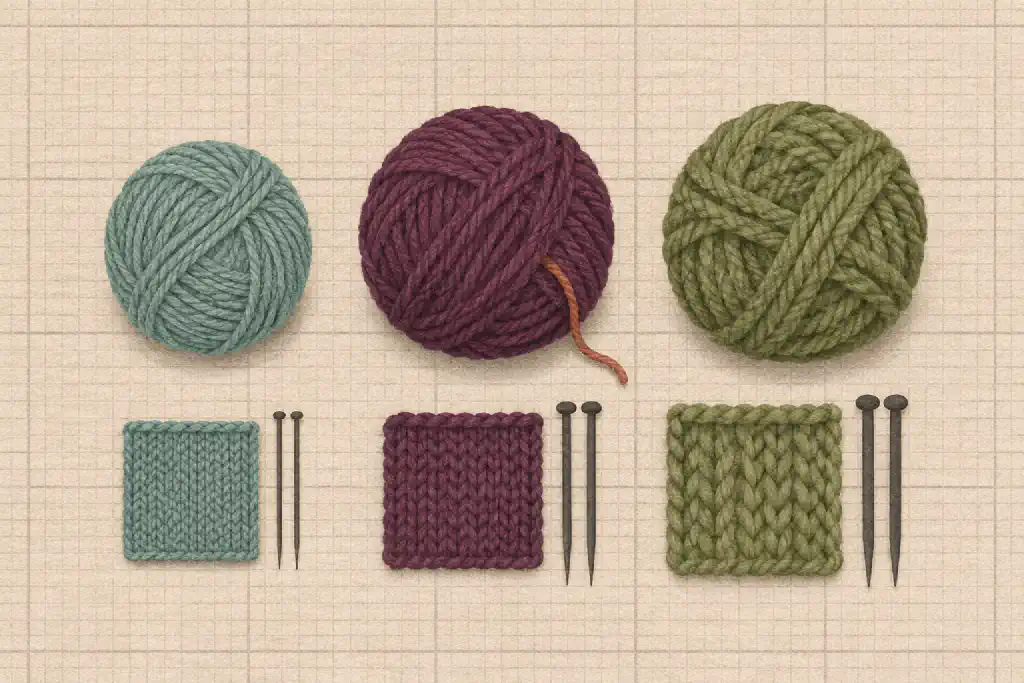
DK stands for double knitting, and it’s a yarn thickness. Mary Maxim, a yarn company, calls it “a name rooted in British yarn tradition” and says “it doesn’t mean you knit with two strands.” The Craft Yarn Council (CYC) lists “DK, Light Worsted” in its category 3 Light, between 2 Fine (sport) and 4 Medium (worsted). Gauge is how many stitches fit in 4". CYC’s knit range for DK is 21–24 stitches over 4" on 3.75–4.5 mm (US 5 to 7) needles. Crochet is different: 12–17 single crochet (UK double crochet) over 4" on 4.5–5.5 mm (7 to I-9) hooks.
DK isn’t the double-knitting technique either, which Sarah Stearns of the craft blog Sarah Maker describes as a way to “create two layers of fabric on one set of needles.”
Swapping in a worsted or sport yarn? Swatch it first (knit or crochet a small test square), then let the yarn substitution calculator count the skeins (the wound bundles yarn is sold in) of your yarn. The yarn weight chart has all of CYC’s categories.
DK yarn weight and size: CYC’s sport, DK and worsted rows
In CYC’s table, each step from sport to DK to worsted means fewer stitches per 4" and bigger needles and hooks. Here are the three rows:
| CYC category | Types (CYC’s words) | Knit gauge, 4" (sts = stitches) | Needle | Crochet gauge, 4" (single crochet) | Hook |
|---|---|---|---|---|---|
| 2 Fine | Sport, Baby | 23–26 sts | 3.25–3.75 mm (US 3 to 5) | 16–20 sts | 3.5–4.5 mm (E-4 to 7) |
| 3 Light | DK, Light Worsted | 21–24 sts | 3.75–4.5 mm (US 5 to 7) | 12–17 sts | 4.5–5.5 mm (7 to I-9) |
| 4 Medium | Worsted, Afghan, Aran | 16–20 sts | 4.5–5.5 mm (US 7 to 9) | 11–14 sts | 5.5–6.5 mm (I-9 to K-10½) |
Source: Craft Yarn Council’s www.YarnStandards.com
CYC counts knit gauge in stockinette (knit on the right side, purl on the wrong side) and crochet gauge in single crochet. Its footnote: “GUIDELINES ONLY: The above reflect the most commonly used gauges and needle or hook sizes for specific yarn categories.” So these are the usual sizes, not limits, and a real yarn can sit outside them.
The knitting needle size chart and crochet hook size chart give the US size for each mm.
DK, light worsted, 8 ply: what the label may say
The same thickness goes by more than one name, and the names don’t line up exactly from country to country.
Light worsted. CYC’s table puts “Light Worsted” in the same cell as DK, while plain “Worsted” is 4 Medium. How to tell yarn weight explains why that word needs a second look.
8 ply. Stearns writes: “In Europe and Australia, you might see DK yarn labeled as 8-ply yarn.” A ply is one of the strands twisted together into a yarn. DK is traditionally made up of 8 plies, she adds, but “not all DK yarn is 8-ply”: some has fewer. The Good Yarn, an Australian shop, isn’t consistent: it puts 8 ply beside “#3 - DK / Light Worsted” in its conversion chart, yet its text says “Generally double Knit refers to a yarn that is slightly thicker than 8-ply.” and “A 8-ply yarn in Australia is similar to a worsted weight yarn in America.”
Our reading: a name is a clue. The label’s gauge and needle or hook size place the yarn. Type them into “Match my label” on the yarn weight chart.
DK vs worsted
Worsted is the next weight up. In CYC’s table, the knit ranges don’t meet, but the crochet ranges and the tool sizes do:
- Knit gauge: DK is 21–24 stitches, worsted 16–20. No stitch count is in both.
- Crochet gauge: DK is 12–17 single crochet, worsted 11–14. Counts of 12, 13 and 14 fit both.
- Needles: the ranges meet at one size, 4.5 mm (US 7), the top of DK’s and the bottom of worsted’s.
- Hooks: they meet at 5.5 mm (I-9).
On the same needle, Mary Maxim says, worsted in place of DK usually gives “a tighter, denser fabric and fewer stitches per inch”, so the piece can come out larger than planned.
CYC’s table and Sarah Maker agree that worsted is the thicker of the two: “Worsted weight yarn is a bit heavier than DK weight yarn.”
Real yarns don’t always respect the line. In a Purl Soho article, Andrea Lotz writes: “But all of these categories are more of a spectrum than buckets, and nothing beats actually knitting with your yarn to find the one that works for you!” The shop describes one of its own yarns, Ochre, as “Spanning DK and worsted weight”. On the Knitting Paradise forum, a member wrote that DK is usually category 3 and worsted category 4, then: “However, unfortunately, there is not total consistency.”
DK vs sport
Sport is the next weight down, and here the ranges overlap in both crafts:
- Knit gauge: 23 and 24 stitches fit both (sport is 23–26, DK 21–24).
- Crochet gauge: 16 and 17 single crochet fit both (sport is 16–20, DK 12–17).
- Needles: they meet at 3.75 mm (US 5).
- Hooks: they meet at 4.5 mm (7).
On the same needle, Mary Maxim says, sport in place of DK often gives a looser, lighter fabric, and you may get more stitches per inch than the pattern expects, which can make the piece smaller.
Knitters disagree on how much it matters. In a Knitting Paradise thread about a DK baby cardigan worked in a sport yarn, one member wrote: “As a general rule baby sport weight is finer than dk so the sweater will turn out smaller.” Another answered: “Sport is not hugely different to DK so I don’t think it will make much difference but the only way to tell is by swatching……as we know!”
Can I use worsted or sport instead of DK?
Sometimes, if your swatch matches the pattern’s gauge. The yarn’s name alone doesn’t settle it.
- Yes, with care. Stearns suggests: “If you don’t have DK weight yarn, you can try substituting a lighter worsted weight yarn or a heavier sport weight yarn.” She warns that the gauge will be different, so you may need another needle size.
- Swatch first, whatever the label says. As Mary Maxim puts it, “We always recommend swatching after any substitution, even when two yarns seem very close on paper.”
The math
If you keep the pattern’s stitch counts, the piece’s width is multiplied by the pattern’s gauge divided by yours. To illustrate with the ends of CYC’s gauge ranges (not real yarns):
- Knit: a DK pattern at 21 stitches per 4", worked in a worsted at 20, comes out 5% wider. At 24 against 16, it’s 50% wider.
- Crochet: a DK pattern at 17 single crochet, worked in a worsted at 11, comes out 54.5% wider.
To change the stitch counts instead, use “Resize a pattern” in the gauge calculator.
How to check a swap
- Find the pattern’s gauge: the stitches over 4", the stitch it’s measured in, and the needle or hook.
- Swatch and measure. Work your yarn in that stitch, starting on the pattern’s needle or hook; how to make a gauge swatch covers the size and blocking. To measure it, use a needle gauge with a stitch-gauge rulerad, which checks stitch and row gauge and can verify a needle’s size.
- Count and adjust. Mary Maxim’s rule for knitting: “If your swatch feels too tight and your stitch count runs high, try going up a needle size. Too loose? Go down a size.” Our advice: the same goes for a crochet hook. Swatch again after each change; see when your swatch doesn’t match.
- Buy by yards. Once it matches, the yarn substitution calculator counts the skeins of your yarn that cover the pattern’s yardage, and shows how the two labels’ yards per gram compare. Our advice: if you only reach gauge on a different size, the pattern’s yardage may not hold, so weigh your swatch and use the yarn calculator.
What is DK yarn used for?
The sources that name uses point mostly to garments and baby items. Stearns calls DK “great for garments” because it’s a lighter-weight yarn. Mary Maxim lists “Soft baby garments, fitted sweaters, hats, shawls, lightweight accessories” and says DK works as well in crochet as in knitting.
Common mistakes
- Reading “DK” as two strands. It’s one yarn of one thickness.
- Assuming crochet has the same gap as knitting. In crochet, DK and worsted share 12–14 single crochet.
- Swapping on the name alone. Even within one category, Purl Soho says, fiber content, spin and how you knit all affect gauge.